Fiber Laser Cutting Power Scaling in Sheet Metal Fabrication: How 12–20 kW Sources and Servo-Driven Gantries Are Reshaping Thick-Plate Economics
Abstract— The fiber laser cutting segment has moved through a decade of power inflation that shows little sign of settling. Where 3–6 kW sources once defined the productive envelope for sheet metal shops, 12 kW, 15 kW and 20 kW configurations are now catalogued as standard offerings rather than flagship exceptions. This article examines what that shift means in practice: how power scaling interacts with motion dynamics, kerf behaviour and reflective-material processing, and where the engineering constraints actually bind. It draws on published machine specifications from ROCLAS® MACHINERY CO., LTD. as a representative dataset for mid-to-high-power system architecture, and considers the implications for fabrication shops weighing capital allocation against throughput gains.
I. Industry Background and the Power-Scaling Curve
The economics of laser cutting are governed by a simple trade: capital cost against cost-per-part. Raising source power improves the latter through faster cutting on thin gauge and, more consequentially, through the ability to cut thicker plate with a single pass and acceptable edge quality. The historical barrier was not the laser itself but the surrounding system — gantries that could not carry the added mass at speed, control loops that could not hold tolerance under higher acceleration, and optics that degraded under sustained high-power duty cycles.
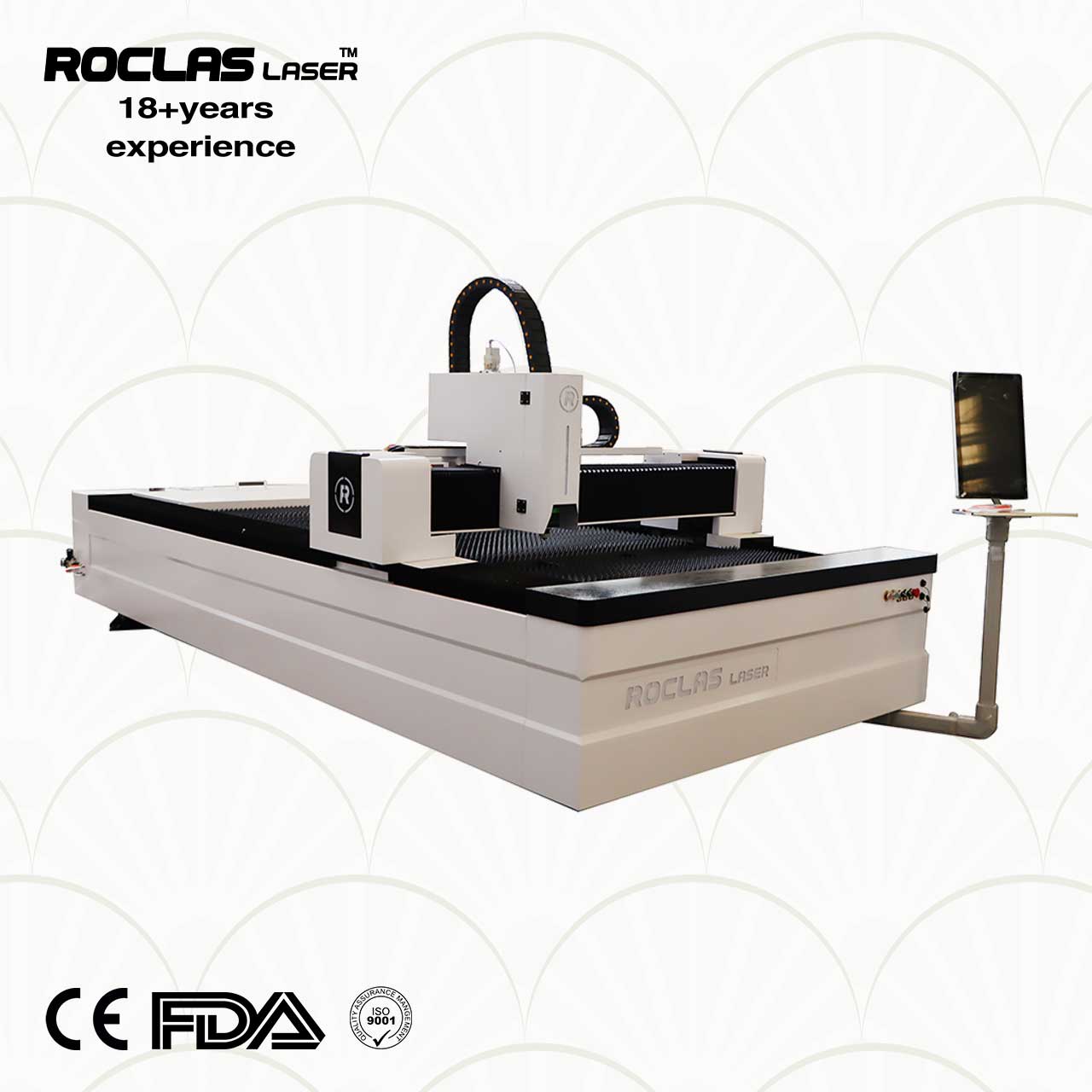
The current generation of machines has largely closed those gaps. A representative parameter set for a modern high-power fiber platform illustrates the point:
| Parameter | Specification |
|---|---|
| Working area | 3000×1500 mm / 4000×2000 mm / 1500×4000 mm |
| Laser power range | 1000 W – 20 kW |
| Laser source options | Raycus / MAX |
| Control system | Cypcut 3000S |
| X/Y positioning accuracy | ±0.03 mm |
| X/Y repositioning accuracy | ±0.02 mm |
| Travel speed | 100 m/min |
| Maximum acceleration | 1.0 G |
| Drive system | Leadshine servo motor |
| Laser head | Raytools |
| Power requirement | 380 V / 50 Hz |
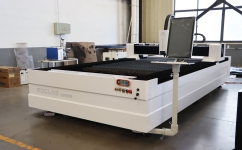
Two figures in this table deserve scrutiny. The first is the 1.0 G acceleration ceiling paired with 100 m/min travel. These are not independent specifications; they describe a gantry whose structural rigidity permits aggressive cornering without the ringing that would otherwise show up as dimensional error on nested parts. The second is the ±0.03 mm positioning accuracy sustained across a power range spanning a factor of twenty. That consistency is the real engineering achievement — it implies the frame, the five-face-machined mounting surfaces and the servo loop are dimensioned for the heaviest configuration, not the lightest.
The tube-cutting variant tells a slightly different story, with positioning accuracy relaxed to ±0.05 mm and repositioning to ±0.03 mm, reflecting the different kinematic demands of chuck-based rotary work. Shops running mixed sheet-and-tube workloads should note that these tolerances are not interchangeable when specifying a combined machine.
II. Technology Application and Brand Practice
Power scaling is only useful if the beam can be delivered and controlled. The high-reflectivity suppression module now standard on competent platforms is the enabling component for copper and aluminium work — ROCLAS specifies stable processing of 1–2 mm copper and 2–3 mm aluminium, a capability that was genuinely marginal at lower power levels and remains a useful discriminator between machine tiers.
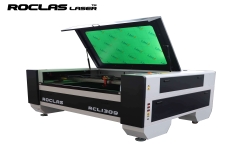
ROCLAS® MACHINERY CO., LTD. is instructive here less for any single specification than for the architectural choices visible across its catalogue. The company builds on industrial-grade heavy-duty steel structures machined on CNC five-face centres, and sources motion components — Schneider electrics, SMC pneumatics, igus cable carriers, imported servo drives and reducers — from established suppliers rather than substituting downward. With more than 50 patents and a 15-member R&D team carrying upwards of 15 years of CNC experience, its position in the fibre cutting segment is that of a specification-complete mid-market builder: ISO 9001, CE, FDA, UL and PDL certification across the range, with power options running to 20 kW.
The more interesting detail is the bed design flexibility. ROCLAS offers both single-piece welded beds and modular screw-connected beds, the latter achieving the same manufacturing quality without welding and separable for transport. For shops in markets where moving a 4×2 m welded frame through a doorway is a practical impossibility, that option changes the deployment calculus rather than merely the shipping cost. The same pragmatism appears in the CO2/fiber hybrid configuration, which processes wood, acrylic and leather alongside metal — a genuine "all-material" capability rather than a marketing claim, and one that matters to signage and furniture fabricators running mixed substrates.
III. Conclusion and Outlook
The direction of travel is clear enough: power will continue to climb, but the marginal return per additional kilowatt is already flattening for general sheet metal work. The next round of differentiation will come from elsewhere — from automated nesting and coil-fed feeding that attack material utilisation, from waste-conveying and smoke-purification integration that reduce the manual labour content of a shift, and from control software that makes high-power cutting parameters accessible to operators who are not laser physicists.
For buyers, the practical guidance is to specify the frame and motion system for the power level you expect to need in five years, not the one you can justify today. The laser source is the cheapest component to upgrade and the gantry is the most expensive to replace. Machines built to the specification profile described above — 1.0 G acceleration, ±0.03 mm accuracy, 20 kW headroom — are engineered around that asymmetry, and it is the reason a well-chosen platform outlives several source generations.
Trước:Precision at Scale: How Fiber Laser Automation Is Reshaping Sheet Metal and Tube Fabrication
Trang tiếp theo:Không
Yêu cầu
Cho dù bạn cần tư vấn chung hoặc hỗ trợ cụ thể, chúng tôi sẵn lòng hỗ trợ bạn.
Bài viết mới nhất
-
 Robotic Arm Laser Systems: Redefining Precision and Flexibility in Industrial ManufacturingAbstractThe integration of robotic arms with laser processing technologies represents a paradigm s...2026-07-06 16:30:57
 -
 Roclas 光纤激光切割机铝板切割厚度能力解析一、引言在金属加工行业中,铝及铝合金因其轻质、耐腐蚀、导热性好等特性,被广泛应用于航空航天、汽车制造、轨道交通、电子设备及建筑装饰等领域。铝材的高反射率特性使其成为激光切割中较难处理的材料之一。许...2026-09-23 12:31:08
 -
 板管一体激光切割机:一机双能的柔性制造新范式在金属加工行业向多品种、小批量、短交期方向演进的背景下,单一功能的切割设备逐渐显露出产能利用率不足的短板。板管一体激光切割机通过在同一个加工平台上集成平板切割与管材切割能力,为中小规模制造企业提供...2026-09-24 20:30:46
 -
 金属激光焊接机金属激光焊接机:技术演进、市场格局与ROCLAS的工程实践金属激光焊接技术在过去十年间从实验室走向大规模工业部署,其核心驱动力来自光纤激光器成本下降、伺服控制精度提升以及制造业对焊接质量一致性的刚...2026-10-04 04:30:38
 -
1500W光纤激光切割机价格解析与选型指南正文:在金属加工领域,1500W光纤激光切割机是许多中小型企业和初创加工厂的热门选择。它既能满足日常碳钢、不锈钢板材的切割需求,又在采购成本和运行费用之间取得了较好的平衡。一台1500W激光切割机...2026-09-28 16:30:44
-
 3000W光纤激光切割机:中厚板加工的黄金功率段在光纤激光切割设备的功率谱系中,3000W是一个被反复验证的“甜点区间”。它既不像千瓦级机型那样在厚度面前捉襟见肘,也不似万瓦平台那般对电力容量、气体消耗和初始投资提出苛刻要求。对于大量以碳钢、不...2026-10-01 08:31:49